
Abstract
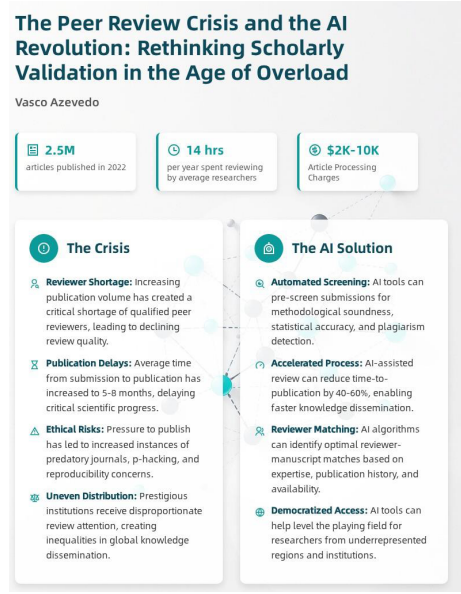
The peer review system, long considered the backbone of scientific integrity, is under unprecedented strain. With over 2.5 million submissions annually and a shrinking pool of qualified reviewers, delays, ethical oversights, and editorial burnout have become endemic. This article outlines the scope of the crisis and proposes AI-augmented peer review as a scalable, ethical, and efficient solution. We present conceptual and quantitative illustrations to support this claim.
Keywords: Peer Review Crisis, AI-Augmented Peer Review, Article Processing Charges, Reviewer Matching, Ethical Oversight, Researcher Workload, Academic Publishing
Introduction: A System at Breaking Point
The peer review system shows signs of exhaustion, resulting from the mismatch between the growing volume of scientific production and the limited capacity to evaluate it rigorously and swiftly. A structural imbalance worsens this scenario: publishers charge high publication fees, while reviewers—responsible for ensuring the quality of the process—are rarely compensated. This asymmetry leads to declining reviewer engagement, directly affecting the efficiency and reliability of scientific publishing.
In 2020, an estimated 100 million hours were dedicated to peer review, equivalent to 15,000 years of unpaid labor and a global cost exceeding US$2 billion (Aczel, Szaszi, and Holcombe 2021). During the same period, scientific articles increased from 0.65 million in 1980 to 3.16 million in 2018, placing greater pressure on reviewers, editors, and editorial workflows (To & Yu, 2020). Additionally, the average number of articles per journal tripled between 1980 and 2020, further exacerbating reviewer overload (Thelwall & Sud, 2022). These data point to a structural fragility: the current peer review system lacks effective mechanisms to recognize or incentivize evaluative work. This reliance on voluntary labor, with limited institutional recognition, undermines the long-term sustainability and legitimacy of the process (see Figure 1: The Peer Review Crisis & AI Rescue – The Human Cost of Reviewer Scarcity).
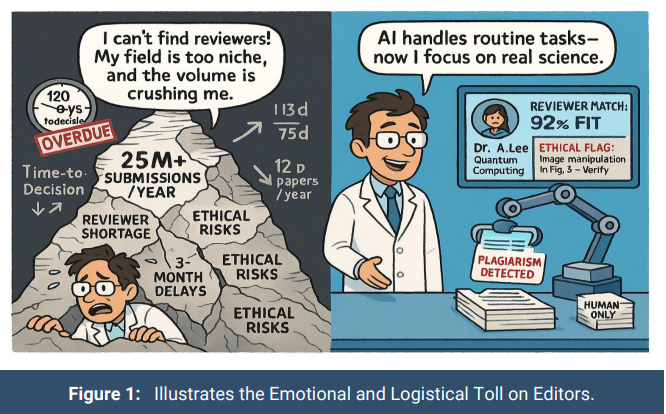
On the left, a researcher is buried under a mountain of submissions, with cracks labeled “Reviewer Shortage,” “3-Month Delays,” and “Ethical Risks.” A speech bubble reads: “I cannot find reviewers! My field is too niche, and the volume is crushing me.” On the right, the same researcher stands confidently, aided by AI tools that detect plagiarism, flag ethical concerns, and match reviewers highly. The visual transition from chaos to clarity underscores the transformative potential of AI.
Peer review has shown vulnerability to the demands of contemporary science, particularly in emerging fields such as AI ethics, quantum computing, and synthetic biology, where expertise is scarce and continuously evolving. Based on manual assessment, the traditional model tends to be slow, inconsistent, and poorly suited to scientific output’s current scale and pace. However, these limitations appear more pronounced in specific niches and should not be interpreted as evidence of a systemic failure. Editors report increasing difficulty recruiting reviewers due to workload pressures and the lack of structural incentives (Henderson et al., 2020). Conversely, targeted studies suggest that reviewer response rates remain stable in some specialized journals, indicating that part of the perceived crisis may stem from premature generalizations (Zupanc, 2024).
The current system operates as a self-sustaining cycle in which intellectual capital functions simultaneously as product and currency. Publishers have reinforced this logic under the discourse of “serving science,” converting unpaid specialized labor into institutional prestige. Few business models precisely align academic merit and commercial success, revealing a strategic approach and a deep understanding of the motivations that drive scientific research. The lack of reviewer compensation is another critical factor to consider amid the current crisis, which shows strong signs of being structural. Elements such as the massive volume of submissions and editorial management challenges exacerbate the issue and present opportunities for mitigation. Institutional initiatives like pre-assigning reviewers and providing financial compensation have reduced the average decision time from 38 to just 4.6 days, without compromising quality (Gorelick & Clark, 2025). However, a significant methodological gap remains: there is a lack of empirical studies exploring why reviewers decline invitations. Predictive surveys and behavioral analyses could help bridge this gap and guide more effective interventions. Structural solutions remain limited and imprecise without such a diagnosis, underscoring the urgency of a scientific approach to understanding and reforming this essential process.
The lack of reviewer compensation is another critical factor to consider amid the current crisis, which shows strong signs of being structural. Elements such as the massive volume of submissions and editorial management challenges exacerbate the issue and present opportunities for mitigation. Institutional initiatives like pre-assigning reviewers and providing financial compensation have reduced the average decision time from 38 to just 4.6 days, without compromising quality (Gorelick & Clark, 2025). However, a significant methodological gap remains: there is a lack of empirical studies exploring why reviewers decline invitations. Predictive surveys and behavioral analyses could help bridge this gap and guide more effective interventions. Structural solutions remain limited and imprecise without such a diagnosis, underscoring the urgency of a scientific approach to understanding and reforming this essential process.
One of the proposed alternatives to mitigate the overload of the peer review system is integrating artificial intelligence into the evaluation process—a proposal that brings both opportunities and risks. In the current landscape, the use of AI appears nearly inevitable: while the benefits are evident, legitimate concerns remain regarding the confidentiality and security of submitted manuscripts. Early studies had already highlighted this potential. Checco (2021) demonstrated that machine learning systems can accurately predict editorial decisions, reducing redundancies and optimizing the time invested by human reviewers. AI-based language models can assist editors in initial manuscript screening, particularly in identifying methodological flaws and verifying compliance with editorial guidelines. These systems have demonstrated superior performance to human reviewers in technical tasks such as plagiarism detection and correcting formal inconsistencies, enabling evaluators to focus on critically analyzing scientific content (Bauchner & Rivara). Artificial intelligence has transformed the peer review process by automating critical editorial screening stages, such as reviewer selection and preliminary quality checks. AI-based tools have proven helpful in identifying suitable reviewers and reducing editorial workload, contributing to greater efficiency in manuscript processing (Kousha & Thelwall, 2024).
In an empirical analysis, using algorithms for reviewer selection resulted in a 73% increase in efficiency, with 42% agreement compared to selections made by human evaluators. Additionally, 37% of the AI-suggested reviewers who were initially dismissed were later deemed appropriate by editors (Farber, 2024). However, despite these promising results, peer review involves complex and sensitive disciplinary criteria that may be distorted by algorithms if not adequately controlled (Farber, 2024).
Ethical Oversight and Reviewer Matching
Despite its operational advantages, using artificial intelligence in peer review presents significant limitations. Based on pre-existing patterns, these models lack interpretive autonomy and cannot assess truly innovative contributions, limiting their role to auxiliary tasks (Crawford, Allen, and Lodge 2024). Furthermore, the use of public AI tools raises ethical and security concerns. Confidentiality breaches are risky, as the systems can store unpublished texts, exposing sensitive data to leaks and misuse (Bauchner & Rivara, 2024; Crawford et al., 2024). To mitigate these risks, adopting robust security protocols—such as controlled environments and data encryption—is recommended to ensure the integrity of the editorial process (Doskaliuk et al., 2025).
Critics of artificial intelligence warn of risks related to bias, opacity, and the dehumanization of scientific judgment. After all, can an algorithm recognize originality? Can it understand the cultural or disciplinary context of an idea? These are legitimate—and necessary—concerns. However, the most productive path is not to reject AI, but to integrate it responsibly. Hybrid models are the most effective, in which machines perform initial screening and flag inconsistencies while humans validate and interpret results. Recent studies confirm this trend: Khraisha et al. (2024) observed that GPT-4 achieves performance comparable to human reviewers only when supervised. The message is clear: the future of peer review lies not in replacing human judgment with AI, but in combining both ethically, transparently, and complementarily. In a similar study, Khan et al. (2025) demonstrated that when simulating the work of two human reviewers, GPT-4-turbo achieved a mean accuracy of 0.94 and reduced errors through cross-critique with other language models. These findings suggest that incorporating LLMs like GPT-4 can enhance review consistency and optimize editorial time—provided they are combined with continuous human validation and transparent decision-making protocols. This is essential to ensure quality and ethics in peer review and scientific publishing.
Reframing the Role of Human Editors
The future of peer review is moving toward a decentralized, data-driven model as artificial intelligence redefines
how knowledge is circulated and validated. Rather than replacing human judgment, AI is likely to reconfigure collaborative networks by connecting reviewers from diverse contexts and fostering greater diversity and transparency. Recent studies indicate that intelligent systems already enable the tracking of editorial decisions, the mapping of conflicts of interest, and the individual recognition of reviewer contributions—previously invisible elements within the scientific process (Farber, 2024; Kousha & Thelwall, 2024).
Artificial intelligence can potentially expand reviewer participation in historically underrepresented contexts,
promoting greater diversity in scientific evaluation. AIassisted systems can reduce logistical and linguistic barriers, enabling the involvement of researchers from diverse regions and disciplinary backgrounds (Farber, 2024). However, this democratizing potential depends on conscious political and technical decisions. Without proper regulation, algorithms may replicate or intensify existing inequalities. Therefore, the use of AI requires not only technological innovation but also a commitment to scientific and epistemological equity.
While operating on large databases to suggest experts, intelligent systems have demonstrated conclusive utility
in identifying suitable reviewers. They are practical tools to optimize editorial tasks that demand time and specialized expertise from researchers (Kousha & Thelwall, 2024). By reconfiguring peer collaboration networks,
these technologies strengthen practices aligned with open science and shared responsibility (Denden & Abed, 2025).
Integrating artificial intelligence into peer review demands urgent implementation of clear ethical and regulatory frameworks that balance technological efficiency with scientific responsibility. Enthusiasm for automation must not override fundamental principles of transparency, equity, and human oversight, which have guided responsible research conduct for decades. Scientific ethics depends on institutional governance systems that ensure accountability and public trust (McCrea et al., 2024).
Historically marked by bias and opacity, peer review requires that any innovation—including artificial intelligence—be accompanied by control and audit mechanisms (Seghier, 2025). Recent guidelines reinforce the shared responsibility among editors, reviewers, and institutions in preventing editorial misconduct, highlighting the importance of addressing the ethical dimensions involved and establishing a global code of conduct for ethical and sustainable editorial practices, particularly within the Information Systems community (Eckhardt & Breidbach, 2024). The quality of peer review depends on cooperation between journals and research institutions (Garfinkel et al., 2023). Building ethical AI governance is not merely a technical challenge, but a moral imperative. Without participatory regulation, the advancement of scientific automation risks undermining justice, transparency, and the integrity of the editorial process.
Conclusion: Toward a Hybrid Future
The crisis in peer review does not represent a system failure, but rather reflects a model designed for a pre-digital era. Artificial intelligence does not replace reviewers but enables them to focus on the most intellectually relevant tasks. By automating repetitive processes, increasing precision, and expanding participation, AI can help restore scientific evaluation’s credibility and accelerate knowledge advancement. The future of science does not belong exclusively to humans or machines, but to their strategic collaboration. In this new ecosystem, knowledge integrity will depend on hybrid systems capable of responding responsibly to the challenges of the information age.
Acknowledgements
The author, a non-native English speaker, acknowledges using AI tools for language refinement and figure generation to ensure clarity and precision in this manuscript. This work was supported by the Brazilian National Council for Scientific and Technological Development (CNPq) under Research Productivity Grant and additional projects. Financial support from the Coordination for the Improvement of Higher Education Personnel (CAPES) and the Minas Gerais Research Foundation (FAPEMIG) for laboratory research projects is also gratefully acknowledged. The author sincerely appreciates the anonymous editorial teams of the journals for which they serve as an associate editor for their dedication to scholarly excellence.
Declaration of the Use of Generative AI
This text was produced with the support of two academic writing tools based on artificial intelligence developed by Joyce Dutra. The first is the BACP Method, which employs the GPT-5 model to assist in the construction of argumentative paragraphs through four stages: Big Idea (thesis definition), Acervo (analysis of scientific literature), Connection (synthesis across studies), and Critical Thinking (authorial reflection). The second is Agente P.A.T.O. (Articulated Thinking for Objective Texts), an instance of the GPT-4o model designed for scientific revision, with a focus on clarity, logic, conciseness, and academic rigor, based on the guidelines of the Gilson Volpato method. Both tools served as cognitive mediators, offering suggestions and linguistic improvements, without replacing authorship, critical reasoning, or the researchers’ interpretations.
References
-
Aczel, Balazs, Barnabas Szaszi, and Alex O. Hol combe. 2021. “A Billion-Dollar Donation: Estimating the Cost of Researchers’ Time Spent on Peer Review.” Research Integrity and Peer Review 6(1): 4–11. doi: 10.1186/s41073-021-00118-2.
-
Bauchner, Howard, and Frederick P. Rivara. 2024. “Use of Artificial Intelligence and the Future of Peer Review.” Health Affairs Scholar 2(5): 1–3. doi: 10.1093/haschl/qxae058.
-
Checco, Alessandro. 2021. “AI-Assisted Peer Review.” 1–11.
-
Crawford, Joseph, Kelly Ann Allen, and Jason Lodge. 2024. “Humanising Peer Review with Artificial Intelligence: Paradox or Panacea?” Journal of University Teaching and Learning Practice 21(1). doi: 10.53761/xeqvhc70.
-
Denden, Mouna, and Mourad Abed. 2025. “Towards Promoting the Culture of Sharing: Using Blockchain and Artificial Intelligence in an Open Science Platform.” International Journal of Interactive Multimedia and Artificial Intelligence 9(2): 104–12. doi: 10.9781/ijimai.2025.02.012.
-
Doskaliuk, Bohdana, Olena Zimba, Marlen Yessirkepov, Iryna Klishch, and Roman Yatsyshyn. 2025. “Artificial Intelligence in Peer Review: Enhancing Efficiency While Preserving Integrity.” Journal of Korean Medical Science 40(7): 1–9. doi: 10.3346/jkms.2025.40.e92.
-
Eckhardt, Andreas, and Christoph F. Breidbach. 2024. “Ethics II: Editorial Conduct.” Information Systems Journal 34(4): 965–69. doi: 10.1111/isj.12499.
-
Farber, Shai. 2024. “Enhancing Peer Review Efciency: A Mixed-Methods Analysis of Artificial Intelligence-Assisted Reviewer Selection across Academic Disciplines.” Learned Publishing 37(4): 1–11. doi: 10.1002/leap.1638.
-
Garfinkel, Susan, Sabina Alam, Patricia Baskin, Christina Bennett, Bridget Carruthers, Jeffrey Engler, Annette Flanagin, Sheila Garrity, Chris Graf, Michael J. Imperiale, Christopher King, Sabine Kleinert, Dan Kulp, Courtney Mankowski, Nicola Nugent, Teodoro Pulvirenti, Lauran Qualkenbush, Emily Sobiecki, Daniel Wainstock, Erica Wilfong, Loren Wold, and Jennifer Yucel. 2023. “Enhancing Partnerships of Institutions and Journals to Address Concerns About Research Misconduct: Recommendations From a Working Group of Institutional Research Integrity Officers and Journal Editors and Publishers.” JAMA Network Open 6(6):E2320796. doi: 10.1001/jamanetworkopen.2023.20796.
-
Gorelick, Daniel A., and Alejandra Clark. 2025. “Fast & Fair Peer Review: A Bold Experiment in Scientific Publishing.” Biology Open 14(3): 2–3. doi: 10.1242/bio.061982.
-
Henderson, Scott, Michael Berk, Philip Boyce, Anthony F. Jorm, Cherrie Galletly, Richard J. Porter, Roger T. Mulder, and Gin S. Malhi. 2020. “Finding Reviewers: A Crisis for Journals and Their Authors.” Australian and New Zealand Journal of Psychiatry 54(10): 957–959. doi: 10.1177/0004867420958077.
-
Khan, Muhammad Ali, Umair Ayub, Syed Arsalan Ahmed Naqvi, Kaneez Zahra Rubab Khakwani, Zaryab bin Riaz Sipra, Ammad Raina, Sihan Zhou, Huan He, Amir Saeidi, Bashar Hasan, Robert Bryan Rumble, Danielle S. Bitterman, Jeremy L. Warner, Jia Zou, Amye J. Tevaarwerk, Konstantinos Leventakos, Kenneth L. Kehl, Jeanne M. Palmer, Mohammad Hassan Murad, Chitta Baral, and Irbaz bin Riaz. 2025. “Collaborative Large Language Models for Automated Data Extraction in Living Systematic Reviews.” Journal of the American Medical Informatics Association 32(4): 638–647. doi: 10.1093/jamia/ocae325
-
Khraisha, Qusai, Sophie Put, Johanna Kappenberg, Azza Warraitch, and Kristin Hadfield. 2024. “Can Large Language Models Replace Humans in Systematic Reviews? Evaluating GPT-4’s Efficacy in Screening and Extracting Data from Peer-Reviewed and Grey Literature in Multiple Languages.” Research Synthesis Methods 15(4): 616–626. doi: 10.1002/jrsm.1715.
-
Kousha, Kayvan, and Mike Thelwall. 2024. “Artificial Intelligence to Support Publishing and Peer Review: A Summary and Review.” Learned Publishing 37(1): 4–12. doi: 10.1002/leap.1570.
-
McCrea, Rod, Rebecca Coates, Elizabeth V. Hobman, Sarah Bentley, and Justine Lacey. 2024. “Responsible Innovation for Disruptive Science and Technology: The Role of Public Trust and Social Expectations.” Technology in Society 79(December 2023):102709. doi: 10.1016/j.techsoc.2024.102709.
-
Seghier, Mohamed L. 2025. “AI-Powered Peer Review Needs Human Supervision.” Journal of Information, Communication and Ethics in Society 23(1):104–116. doi: 10.1108/JICES-09-2024-0132.
-
Thelwall, Mike, and Pardeep Sud. 2022. “Scopus 1900–2020: Growth in Articles, Abstracts, Countries, Fields, and Journals.” Quantitative Science Studies 3(1):37–50. doi:10.1162/qss_a_00177.
-
To, W. M., and Billy T. W. Yu. 2020. “Rise in Higher Education Researchers and Academic Publications.” Emerald Open Research 2(September):3. doi: 10.35241/emeraldopenres.13437.1
-
Zupanc, Günther K. H. 2024. “‘It Is Becoming Increasingly Difficult to Find Reviewers’—Myths and Facts about Peer Review.” Journal of Comparative Physiology A: Neuroethology, Sensory, Neural, and Behavioral Physiology 210(1): 1–5. doi: 10.1007/s00359-023-01642-w.

Figure:

Figure1:
-
Aczel, Balazs, Barnabas Szaszi, and Alex O. Hol combe. 2021. “A Billion-Dollar Donation: Estimating the Cost of Researchers’ Time Spent on Peer Review.” Research Integrity and Peer Review 6(1): 4–11. doi: 10.1186/s41073-021-00118-2.
-
Bauchner, Howard, and Frederick P. Rivara. 2024. “Use of Artificial Intelligence and the Future of Peer Review.” Health Affairs Scholar 2(5): 1–3. doi: 10.1093/haschl/qxae058.
-
Checco, Alessandro. 2021. “AI-Assisted Peer Review.” 1–11.
-
Crawford, Joseph, Kelly Ann Allen, and Jason Lodge. 2024. “Humanising Peer Review with Artificial Intelligence: Paradox or Panacea?” Journal of University Teaching and Learning Practice 21(1). doi: 10.53761/xeqvhc70.
-
Denden, Mouna, and Mourad Abed. 2025. “Towards Promoting the Culture of Sharing: Using Blockchain and Artificial Intelligence in an Open Science Platform.” International Journal of Interactive Multimedia and Artificial Intelligence 9(2): 104–12. doi: 10.9781/ijimai.2025.02.012.
-
Doskaliuk, Bohdana, Olena Zimba, Marlen Yessirkepov, Iryna Klishch, and Roman Yatsyshyn. 2025. “Artificial Intelligence in Peer Review: Enhancing Efficiency While Preserving Integrity.” Journal of Korean Medical Science 40(7): 1–9. doi: 10.3346/jkms.2025.40.e92.
-
Eckhardt, Andreas, and Christoph F. Breidbach. 2024. “Ethics II: Editorial Conduct.” Information Systems Journal 34(4): 965–69. doi: 10.1111/isj.12499.
-
Farber, Shai. 2024. “Enhancing Peer Review Efciency: A Mixed-Methods Analysis of Artificial Intelligence-Assisted Reviewer Selection across Academic Disciplines.” Learned Publishing 37(4): 1–11. doi: 10.1002/leap.1638.
-
Garfinkel, Susan, Sabina Alam, Patricia Baskin, Christina Bennett, Bridget Carruthers, Jeffrey Engler, Annette Flanagin, Sheila Garrity, Chris Graf, Michael J. Imperiale, Christopher King, Sabine Kleinert, Dan Kulp, Courtney Mankowski, Nicola Nugent, Teodoro Pulvirenti, Lauran Qualkenbush, Emily Sobiecki, Daniel Wainstock, Erica Wilfong, Loren Wold, and Jennifer Yucel. 2023. “Enhancing Partnerships of Institutions and Journals to Address Concerns About Research Misconduct: Recommendations From a Working Group of Institutional Research Integrity Officers and Journal Editors and Publishers.” JAMA Network Open 6(6):E2320796. doi: 10.1001/jamanetworkopen.2023.20796.
-
Gorelick, Daniel A., and Alejandra Clark. 2025. “Fast & Fair Peer Review: A Bold Experiment in Scientific Publishing.” Biology Open 14(3): 2–3. doi: 10.1242/bio.061982.
-
Henderson, Scott, Michael Berk, Philip Boyce, Anthony F. Jorm, Cherrie Galletly, Richard J. Porter, Roger T. Mulder, and Gin S. Malhi. 2020. “Finding Reviewers: A Crisis for Journals and Their Authors.” Australian and New Zealand Journal of Psychiatry 54(10): 957–959. doi: 10.1177/0004867420958077.
-
Khan, Muhammad Ali, Umair Ayub, Syed Arsalan Ahmed Naqvi, Kaneez Zahra Rubab Khakwani, Zaryab bin Riaz Sipra, Ammad Raina, Sihan Zhou, Huan He, Amir Saeidi, Bashar Hasan, Robert Bryan Rumble, Danielle S. Bitterman, Jeremy L. Warner, Jia Zou, Amye J. Tevaarwerk, Konstantinos Leventakos, Kenneth L. Kehl, Jeanne M. Palmer, Mohammad Hassan Murad, Chitta Baral, and Irbaz bin Riaz. 2025. “Collaborative Large Language Models for Automated Data Extraction in Living Systematic Reviews.” Journal of the American Medical Informatics Association 32(4): 638–647. doi: 10.1093/jamia/ocae325
-
Khraisha, Qusai, Sophie Put, Johanna Kappenberg, Azza Warraitch, and Kristin Hadfield. 2024. “Can Large Language Models Replace Humans in Systematic Reviews? Evaluating GPT-4’s Efficacy in Screening and Extracting Data from Peer-Reviewed and Grey Literature in Multiple Languages.” Research Synthesis Methods 15(4): 616–626. doi: 10.1002/jrsm.1715.
-
Kousha, Kayvan, and Mike Thelwall. 2024. “Artificial Intelligence to Support Publishing and Peer Review: A Summary and Review.” Learned Publishing 37(1): 4–12. doi: 10.1002/leap.1570.
-
McCrea, Rod, Rebecca Coates, Elizabeth V. Hobman, Sarah Bentley, and Justine Lacey. 2024. “Responsible Innovation for Disruptive Science and Technology: The Role of Public Trust and Social Expectations.” Technology in Society 79(December 2023):102709. doi: 10.1016/j.techsoc.2024.102709.
-
Seghier, Mohamed L. 2025. “AI-Powered Peer Review Needs Human Supervision.” Journal of Information, Communication and Ethics in Society 23(1):104–116. doi: 10.1108/JICES-09-2024-0132.
-
Thelwall, Mike, and Pardeep Sud. 2022. “Scopus 1900–2020: Growth in Articles, Abstracts, Countries, Fields, and Journals.” Quantitative Science Studies 3(1):37–50. doi:10.1162/qss_a_00177.
-
To, W. M., and Billy T. W. Yu. 2020. “Rise in Higher Education Researchers and Academic Publications.” Emerald Open Research 2(September):3. doi: 10.35241/emeraldopenres.13437.1
-
Zupanc, Günther K. H. 2024. “‘It Is Becoming Increasingly Difficult to Find Reviewers’—Myths and Facts about Peer Review.” Journal of Comparative Physiology A: Neuroethology, Sensory, Neural, and Behavioral Physiology 210(1): 1–5. doi: 10.1007/s00359-023-01642-w.