
Abstract
Abstract
The peer review system, long considered the backbone of scientific in
tegrity, is under unprecedented strain. With over 2.5 million submissions
annually and a shrinking pool of qualified reviewers, delays, ethical over
sights, and editorial burnout have become endemic. This article outlines
the scope of the crisis and proposes AI-augmented peer review as a scal
able, ethical, and efficient solution. We present conceptual and quantita
tive illustrations to support this claim.
Keywords : Peer Review Crisis, Ai-Augmented Peer Review, Article Pro
cessing Charges, Reviewer Matching, Ethical Oversight, Researcher
Workload, Academic Publishing
Figures
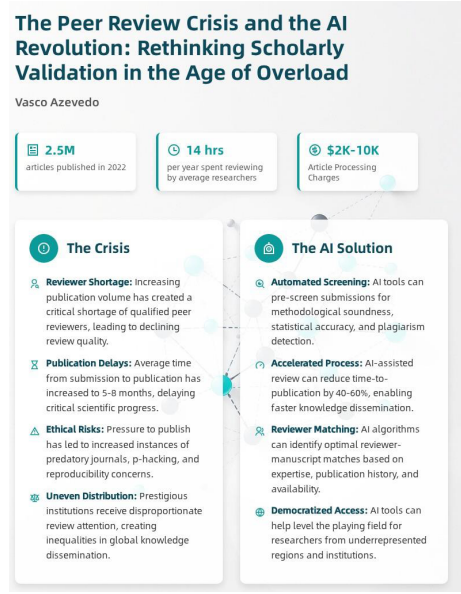
Figure:
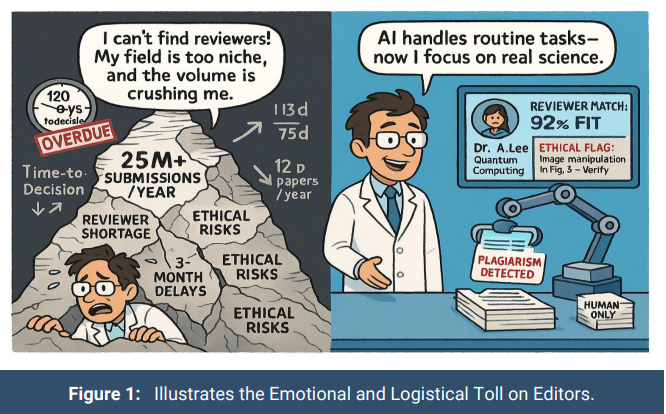
Figure1:
References
-
Aczel, Balazs, Barnabas Szaszi, and Alex O. Hol combe. 2021. “A Billion-Dollar Donation: Estimating the Cost of Researchers’ Time Spent on Peer Review.” Research Integrity and Peer Review 6(1): 4–11. doi: 10.1186/s41073-021-00118-2.
-
Bauchner, Howard, and Frederick P. Rivara. 2024. “Use of Artificial Intelligence and the Future of Peer Review.” Health Affairs Scholar 2(5): 1–3. doi: 10.1093/haschl/qxae058.
-
Checco, Alessandro. 2021. “AI-Assisted Peer Review.” 1–11.
-
Crawford, Joseph, Kelly Ann Allen, and Jason Lodge. 2024. “Humanising Peer Review with Artificial Intelligence: Paradox or Panacea?” Journal of University Teaching and Learning Practice 21(1). doi: 10.53761/xeqvhc70.
-
Denden, Mouna, and Mourad Abed. 2025. “Towards Promoting the Culture of Sharing: Using Blockchain and Artificial Intelligence in an Open Science Platform.” International Journal of Interactive Multimedia and Artificial Intelligence 9(2): 104–12. doi: 10.9781/ijimai.2025.02.012.
-
Doskaliuk, Bohdana, Olena Zimba, Marlen Yessirkepov, Iryna Klishch, and Roman Yatsyshyn. 2025. “Artificial Intelligence in Peer Review: Enhancing Efficiency While Preserving Integrity.” Journal of Korean Medical Science 40(7): 1–9. doi: 10.3346/jkms.2025.40.e92.
-
Eckhardt, Andreas, and Christoph F. Breidbach. 2024. “Ethics II: Editorial Conduct.” Information Systems Journal 34(4): 965–69. doi: 10.1111/isj.12499.
-
Farber, Shai. 2024. “Enhancing Peer Review Efciency: A Mixed-Methods Analysis of Artificial Intelligence-Assisted Reviewer Selection across Academic Disciplines.” Learned Publishing 37(4): 1–11. doi: 10.1002/leap.1638.
-
Garfinkel, Susan, Sabina Alam, Patricia Baskin, Christina Bennett, Bridget Carruthers, Jeffrey Engler, Annette Flanagin, Sheila Garrity, Chris Graf, Michael J. Imperiale, Christopher King, Sabine Kleinert, Dan Kulp, Courtney Mankowski, Nicola Nugent, Teodoro Pulvirenti, Lauran Qualkenbush, Emily Sobiecki, Daniel Wainstock, Erica Wilfong, Loren Wold, and Jennifer Yucel. 2023. “Enhancing Partnerships of Institutions and Journals to Address Concerns About Research Misconduct: Recommendations From a Working Group of Institutional Research Integrity Officers and Journal Editors and Publishers.” JAMA Network Open 6(6):E2320796. doi: 10.1001/jamanetworkopen.2023.20796.
-
Gorelick, Daniel A., and Alejandra Clark. 2025. “Fast & Fair Peer Review: A Bold Experiment in Scientific Publishing.” Biology Open 14(3): 2–3. doi: 10.1242/bio.061982.
-
Henderson, Scott, Michael Berk, Philip Boyce, Anthony F. Jorm, Cherrie Galletly, Richard J. Porter, Roger T. Mulder, and Gin S. Malhi. 2020. “Finding Reviewers: A Crisis for Journals and Their Authors.” Australian and New Zealand Journal of Psychiatry 54(10): 957–959. doi: 10.1177/0004867420958077.
-
Khan, Muhammad Ali, Umair Ayub, Syed Arsalan Ahmed Naqvi, Kaneez Zahra Rubab Khakwani, Zaryab bin Riaz Sipra, Ammad Raina, Sihan Zhou, Huan He, Amir Saeidi, Bashar Hasan, Robert Bryan Rumble, Danielle S. Bitterman, Jeremy L. Warner, Jia Zou, Amye J. Tevaarwerk, Konstantinos Leventakos, Kenneth L. Kehl, Jeanne M. Palmer, Mohammad Hassan Murad, Chitta Baral, and Irbaz bin Riaz. 2025. “Collaborative Large Language Models for Automated Data Extraction in Living Systematic Reviews.” Journal of the American Medical Informatics Association 32(4): 638–647. doi: 10.1093/jamia/ocae325
-
Khraisha, Qusai, Sophie Put, Johanna Kappenberg, Azza Warraitch, and Kristin Hadfield. 2024. “Can Large Language Models Replace Humans in Systematic Reviews? Evaluating GPT-4’s Efficacy in Screening and Extracting Data from Peer-Reviewed and Grey Literature in Multiple Languages.” Research Synthesis Methods 15(4): 616–626. doi: 10.1002/jrsm.1715.
-
Kousha, Kayvan, and Mike Thelwall. 2024. “Artificial Intelligence to Support Publishing and Peer Review: A Summary and Review.” Learned Publishing 37(1): 4–12. doi: 10.1002/leap.1570.
-
McCrea, Rod, Rebecca Coates, Elizabeth V. Hobman, Sarah Bentley, and Justine Lacey. 2024. “Responsible Innovation for Disruptive Science and Technology: The Role of Public Trust and Social Expectations.” Technology in Society 79(December 2023):102709. doi: 10.1016/j.techsoc.2024.102709.
-
Seghier, Mohamed L. 2025. “AI-Powered Peer Review Needs Human Supervision.” Journal of Information, Communication and Ethics in Society 23(1):104–116. doi: 10.1108/JICES-09-2024-0132.
-
Thelwall, Mike, and Pardeep Sud. 2022. “Scopus 1900–2020: Growth in Articles, Abstracts, Countries, Fields, and Journals.” Quantitative Science Studies 3(1):37–50. doi:10.1162/qss_a_00177.
-
To, W. M., and Billy T. W. Yu. 2020. “Rise in Higher Education Researchers and Academic Publications.” Emerald Open Research 2(September):3. doi: 10.35241/emeraldopenres.13437.1
-
Zupanc, Günther K. H. 2024. “‘It Is Becoming Increasingly Difficult to Find Reviewers’—Myths and Facts about Peer Review.” Journal of Comparative Physiology A: Neuroethology, Sensory, Neural, and Behavioral Physiology 210(1): 1–5. doi: 10.1007/s00359-023-01642-w.